Peter Schickele - What Did You Do Today at Jeffey´s House? (corno y arpa)
Pearl Chertok - Suite ¨Around the Clock¨. (arpa)
II. Beige Nocturne.
III. Harpicide at Midnight.
IV. The Morning After.
Ken Gist - Intaglio (corno y arpa)
INTERMEDIO
Franz Strauss (padre de Richard Strauss) - Nocturno (corno y arpa)
Jan Koetsier - Sonate for Horn and Harp, Opus 94 (corno y arpa)
| Top |
JEFFREY ROGERS, horn
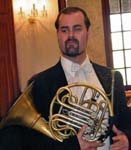 Jeffrey Rogers studied at Rice University under professors William VerMuelen and Bruce Henniss, both horn players with the Houston Symphony. He started his career playing with the Mexico Philharmonic in 1999 as main horn, staying with them for five years.
By the end of 2004 he took a new position on the horn line with the Sinaloa Arts Symphony Orchestra. The following year he was invited to compete in Santiago de Chile for the position of main horn, soloist, with Chile National Orchestra, and he won. In the autumn 2007 he returned to Mexico to take a new position created for him at the Mazatlán Camerata as a soloist, and also to become a horn teacher and director of the Symphony Band at the Mazatlán Superior Music School in the State of Sinaloa.
The following year, he was invited to take part in the main horn competition for the Jalisco Philharmonic Orchestra; he won the position, which he holds to date.
He has participated in several Chamber Music Groups, including the Mexico City Wind Instrument Quintet, the Mexico City Metal Quintet, and others. He has participated in the main music festivals of the country with these groups and also with several orchestras, such as the International Cervantes Festival, New Music Forum, Zacatecas Cultural Festival, Mexico City Historic Center Festival, Mazatlán Cultural Festival and the Ortiz Tirado Festival in Álamos, Sonora, as well as in others.
During summers, he has also been part of the prestigious Mining Symphony Orchestra, for which he plays regularly since 2000.
JANET PAULUS, harp
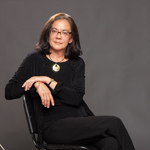 She was born in New York and studied harp with Pearl Chertok, and continued her studies at the Interlochen Arts Academy, in Michigan and at the Cleveland Music Institute, where she got her Bachelor in Music tutored by Alice Chalifoux. As soon as she finished her studies, she became the main harpist for the State of Mexico Symphony Orchestra, and later she was asked to be a member of the Mexico City Philharmonic.
She continued her music career in New York in 1983, both as soloist and in chamber music groups, also performing as orchestral harpist with the Metropolitan Opera Orchestra, the New York Philharmonic, the New York Opera Orchestra, the St. Luke’s Orchestra and the Boston Philharmonic.
She lived in Spain from 1992 to 1997 where she founded the GIOCCARPA harp duet, recording the CD Vent de Terre, Vent de Mer.
She has been harp teacher at the Brooklyn Conservatory, the Manhattan Music School, and has played in the Morelia Music Festival, and is now professor at the National Music School and the Superior Music School as well.
She has recorded with different orchestras: San Francisco Symphony, New York Metropolitan Opera and the New York Philharmonic.
She now lives in Mexico and is main harpist for the OFUNAM, Mexico Autonomous National University Philharmonic Orchestra, the Fine Arts Theater Orchestra and the Mining Symphony Orchestra.
In February 2002, she organized the Second International Harp Festival collaborating with the National Music School and the Mexico City Superior Music School.
Since 1999 she has been part of the SONDOS Harp Duet with Mercedes Gómez, and, starting in 2002, she has been playing with the LUDERE ENSEMBLE, with Francisco Ramírez, flutist and Luis Magaña, viola.
| Top |
PETER SCHICKELE, composer
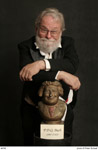 Composer, musician, author, satirist—Peter Schickele is internationally recognized as one of the most versatile artists in the field of music.His works, now well in excess of 100 for symphony orchestras, choral groups, chamber ensembles, voice, movies and television, have given him “a leading role in the ever-more-prominent school of American composers who unselfconsciously blend all levels of American music.” (John Rockwell, The New York Times)
His commissions are numerous and varied, ranging from works for the National Symphony, the Saint Louis Symphony, The Minnesota Opera, The Chamber Music Society of Lincoln Center, The Audubon and Lark String Quartets, the Minnesota Orchestral Association, and many other such organizations to compositions for distinguished instrumentalists and singers.His recent premieres include Concerto for Viola and Orchestra, with Danielle Farina and the Pasadena Symphony under Jorge Mester;Music for Orcas Island, for the 2007 Orcas Island Chamber Music Festival; Symphony No. 2, The Sweet Season, premiered by the Saint Paul Chamber Orchestra under Stefan Sanderling;Concerto for Cello and Orchestra In Memoriam F.D.R.; performed by Paul Tobias with the Pasadena Symphony under Jorge Mester; New Century Suite, a concerto for saxophone quartet and orchestra, commissioned by the New Century Saxophone Quartet and premiered by them with the North Carolina Symphony;New Goldberg Variations for cello and piano, performed by Yo-Yo Ma and Emanuel Ax; Symphony No.1 Songlines, premiered by the National Symphony under Leonard Slatkin, and since performed across the country by orchestras including the New York Philharmonic and the Cleveland Orchestra;Blue Set No. 1, a jazz string quartet commissioned by the Greene Quartet and recorded on the Virgin label, among others.The Armadillo String Quartet has presented annual concerts of Mr. Schickele’s chamber music in Los Angeles since 1991.
Peter Schickele arranged one of the musical segments for the Disney animated feature film, Fantasia 2000.He also created the musical score for the film version of Maurice Sendak’s children’s classic Where the Wild Things Are, issued on videocassette (Weston Woods) and DVD (Scholastic) along with another Sendak classic In the Night Kitchen, which Mr. Schickele narrates.Among his varied projects is a weekly, syndicated radio program, Schickele Mix, which has been heard nationwide over Public Radio International since January 1992 and which won ASCAP’s prestigious Deems Taylor Award.
In 1993 Telarc released a recording of Prokofiev’s Sneaky Pete (a.k.a. Peter) and the Wolf and Saint-Saëns’Carnival of the Animals with new texts authored and narrated by Peter Schickele, accompanied by the Atlanta Symphony Orchestra under Yoel Levi.Mr. Schickele gave the New York premiere of Sneaky Pete and the Wolf at Carnegie Hall as part of the 1993 Toyota Comedy Festival and has performed the Saint-Saëns work with major American orchestras, including the New York Philharmonic at its gala New Year’s Eve concert in 1991.His orchestral programs, P.D.Q. Bach:The Vegas Years and P.D.Q. Bach Strikes Back, as well as his chamber program, P.D.Q. Bach and Peter Schickele:The Jekyll and Hyde Tour, have received wide acclaim.He also continues to tour with a program of original cabaret songs, which he sings from the piano with the harmonizing assistance of David Düsing.Another program, Condition of My Heart, presents reflections on a long marriage in a continuous montage of original songs by Mr. Schickele and poems by his wife, the poet Susan Sindall.
Peter Schickele was born on July 17, 1935, in Ames, Iowa, and brought up in Washington, D.C. and Fargo, North Dakota, where he studied composition with Sigvald Thompson.He graduated from Swarthmore in 1957, having had the distinction of being the only music major (as he had been, earlier, the only bassoonist in Fargo).By that time he had already composed and conducted four orchestral works, a great deal of chamber music and a number of songs.He subsequently studied composition with Roy Harris and Darius Milhaud, and with Vincent Persichetti and William Bergsma at The Juilliard School of Music.He composed music for high schools in Los Angeles under a Ford Foundation grant before returning to teach at Juilliard in 1961.In 1965 he gave up teaching to become the freelance composer/performer he has been ever since.
In the course of his career Schickele has also created music for four feature films, among them the prize-winning Silent Running, as well as for documentaries, television commercials, several Sesame Street segments and an underground movie that he has never seen in its finished state.He was also one of the composer/ lyricists for Oh! Calcutta!, and has arranged for Joan Baez, Buffy Sainte-Marie and other folk singers.
Mr. Schickele and his wife, the poet Susan Sindall, reside in New York City and at an upstate hideaway where he concentrates on composing.His son, Mathew, and his daughter, Karla are involved in various alternative rock groups, both as composers and performers.
FRANZ STRAUSS, composer
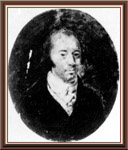 Franz Strauss (26 February 1822 – 31 May 1905) is perhaps most famous for being the father of the well-known composer Richard Strauss. He was an accomplished musician and composer, a virtuous hornist in Europe, also playing other instruments as in the guitar and clarinet, among many others.
Strauss was born Parkstein, Bavaria. He is remembered most often today as a horn player, and was an outstanding horn player in his day. For almost fifty years he was principal horn of the Munich Court Orchestra. This orchestra premiered many of Richard Wagner's great works. Strauss himself performed in the premieres of Tristan und Isolde, Das Rheingold, and Die Walküre. Strauss however intensely disliked the works of Wagner and did not get along well with the composer. Wagner, speaking of Strauss, said, "Strauss is an unbearable, curmudgeonly fellow, but when he plays his horn one can say nothing, for it is so beautiful."
As a composer, Strauss is remembered mostly for the pieces he wrote for the horn. These include two concerts and numerous smaller works. Undoubtedly his son Richard was influenced by hearing one of the great horn players of the time in his own home growing up.
VINCENT PERSICHETTI, composer
 Vincent Ludwig Persichetti (June 6, 1915 – August 14, 1987) was an American composer, teacher, and pianist. An important musical educator and writer, Persichetti was a native of Philadelphia. He was known for his integration of various new ideas in musical composition into his own work and teaching, and for training many noted composers in composition at the Juilliard School.
His students at Juilliard included Philip Glass, Michael Jeffrey Shapiro, Kenneth Fuchs, Richard Danielpour, Robert Dennis, Peter Schickele, Robert Witt and Thelonious Monk. He also taught composition to conductor James DePreist at the Philadelphia Conservatory.
Persichetti is one of the major figures in American music of the 20th century, both as a teacher and a composer. Notably, his Hymns and Responses for the Church Year has become a standard setting for church choirs, and high school and college students' introductions to contemporary music are often made by way of his numerous compositions for wind ensemble. His early style was marked by the influences of Stravinsky, Bartók, Hindemith, and Copland before developing into his own distinct voice in the 1950s.
Persichetti's music draws on a wide variety of thought in 20th century composition as well as Big Band music. His own style was marked by use of two elements he refers to as "graceful" and "gritty": the former being more lyrical and melodic, the latter being sharp and intensely rhythmic. He frequently used polytonality and pandiatonicism in his writing and his music could be marked by sharp rhythmic interjections, but his embracing of diverse strands of musical thought makes characterizing his body of work difficult. This trend continued throughout his compositional career; his music lacked sharp changes in style over time. (Persichetti once proclaimed in an interview in Musical Quarterly that his music was "...not like a woman, that is, it does not have periods!"). He frequently composed in his car, sometimes taping staff paper to the steering wheel.
His piano music forms the bulk of his creative output, with a concerto, a concertino, twelve sonatas, and a variety of other pieces written for the instrument, virtuosic pieces as well as pedagogical and amateur-level compositions; Persichetti was an accomplished pianist. Persichetti wrote many pieces suitable for less mature performers, considering them too to have serious artistic merit. Persichetti is also one of the major composers for the concert wind band repertoire, with his 14 works for the ensemble; the Symphony No. 6 for band is of particular note as a standard larger work. He wrote one opera, entitled The Sibyl; the music was noted by critics for its color, but the dramatic and vocal aspects of the work were found by some to be lacking. He wrote nine symphonies, of which the first two were withdrawn (as were the first two symphonies by two other American composers of the late thirties and early forties, William Schuman and Peter Mennin), and four string quartets. Many of his other works are organized into series. One of these, a collection of primarily instrumental works entitled Parables, contains 25 works, many for unaccompanied wind instruments (complete listing below), and his 15 Serenades include such unconventional combinations as a trio for trombone, viola, and cello as well as selections for orchestra, for band, and for duo piano.
In addition to his frequent appearances as lecturer on college campuses, in which he was noted for his witty and engaging manner, he wrote the famous music theory textbook Twentieth Century Harmony: Creative Aspects and Practice as well as coauthoring a monograph, with Flora Rheta Schreiber, on William Schuman.
JAN KOETSIER, composer
 Was born on 14 August 1911 in Amsterdam, the son of the singer Jeanne Koetsier and the teacher Jan Koetsier-Muller. From an early age he received musical encouragement and support (piano lessons). Koetsier decided to study music early on, entering college straight after leaving school. He moved to Berlin in 1913 with his family, and aged 16, was the youngest student of his day to pass the entrance audition in piano to the Berlin Hochschule für Musik. There, as well as studying piano, he studied score-reading and music theory with Walther Gmeindl, and conducting with Julius Prüwer from 1932. Also encouraged by Artur Schnabel, signs of his future direction in music began to emerge – composing and conducting. In 1933, Koetsier took up a position as a répétiteur at the Stadttheater in Lübeck. But after just one concert season, he returned to Berlin and began working as a conductor touring with theatre ensembles such as the Deutsche Musikbühne and the Deutsche Landesbühne; his repertoire expanded to include music theatre works.
From 1936-37 he had the opportunity of working as a freelance conductor for the short-wave broadcasting station in Berlin, directing broadcasts of his own folk music arrangements, including arrangements of South American and African songs. Because of the political situation, Koetsier gave up his position at the Berlin radio station in 1940 and took up an offer of working as piano accompanist to the dancer Ilse Meudtner on a year-long tour. Following on from this, he worked as conductor of the newly-founded Kammeropera in The Hague, during which he travelled to numerous Dutch towns and cities (1941/42). He then became second conductor of the ‘Concertgebouw Orchestra’ in Amsterdam (1942-48), a central point in his artistic development, which brought with it valuable stimuli and experience, including collaborating with the orchestra’s chief conductor, Willem Mengelberg.
Jan Koetsier in 1937 at the University of Music and Performing Arts Munich, conductingthe Orchestra of Deutsche Landesbühne e.V. Berlin.
He then spent a short period as conductor of the ‘Residentie Orkest’ and as conducting teacher at the Royal Conservatory in The Hague before being invited by Bavarian Radio to become principal conductor of its newly-founded Symphony Orchestra in 1950. Koetsier held this position for sixteen years, working intensively on studio productions of all periods and styles which were required for daily broadcasting. He also conducted public concerts, including some in the Bavarian Radio musica viva series. In 1966 he became professor of conducting at the Hochschule für Musik in Munich, in which position he was involved in reforming the teaching schedule.
After his retirement, Koetsier concentrated mainly on composing at his home in Rattenkirchen, Upper Bavaria. In these years, he founded the International Jan Koetsier Competition for the encouragement of young brass ensembles, since 1999 at the Hochschule für Musik und Theater Munich.
Koetsier’s work with instrumental soloists and ensembles led to numerous commissions. Musicians he frequently worked with included the Philip Jones Brass Ensemble, the Trio Armin Rosin and the Brass Philharmonie founded by Armin Rosin, the Slokar Quartet, the Rennquintett, the Leipziger Hornquartett and the Münchner Blechbläsersolisten, as well as numerous string soloists and pianists. For many of these groups, his works have become an established part of their repertoire. The fact that in his composing, Koetsier always bore practical musical considerations and requirements in mind is also a basic reason for his choice of instrumental combinations and scorings; examples of this are his combination of horn and harp (Sonata, Op. 94), four tubas or trombones (Wolkenschatten, Op. 136, for tuba quartet; Die Bremer Stadtmusikanten, Op. 138, for trombone quartet) or brass quintet and harp (Introduction and Variations on the “Vyšehrad” Theme by Friedrich Smetana, Op. 71). As well as chamber music for wind and strings in various combinations, Koetsier also composed solo concerti (e.g. the Echo Concerto for 2 piccolo trumpets and string orchestra, Op. 124, or the Concerto for Brass Quintet and Orchestra, Op. 133) and numerous orchestral works including symphonies and serenades. Then there is piano and organ music, a few songs, choral works and an opera (Frans Hals, Op. 39).
Many of these compositions have a firmly established place in programme planning in Germany and abroad. Apart from the chamber music, the solo concerti and orchestral works in particular make worthwhile listening; for example, performances of his Concerto for Trumpet, Trombone and Orchestra, Op. 17, by Rafael Kubelik and the Symphonieorchester des Bayerischen Rundfunks and the 3rd Symphony given by the Philadelphia Orchestra in Philadelphia and New York were outstanding events.
Jan Koetsier in 1979 celebrating the 65th birthday of Rafael Kubelik
In 2002 Koetsier gave up composing and moved with his wife Margarete into the Augustinum Home in Munich. He died there on 28 April 2006.
Pearl Chertok was an internationally regarded harpist and composer for harp. She was born on June 18, 1918, in Laconia, New Hampshire, and died in White Plains, New York, on August 1, 1981.
After studying ballet, piano and flute as a child, Chertok forwent her senior year of high school to attend the Curtis Institute of Music in Philadelphia, where she studied with Marjorie Tyre and Carlos Salzedo. She then moved to New York City where she was staff harpist with the CBS Television Orchestra for many years, appearing on shows such as The Arthur Godfrey Show and Ed Sullivan's Toast of the Town.
Chertok recorded several albums, both for solo harp as well ensemble work. Her solo work included her own compositions, many of which employed an innovative jazz idiom. On her Audio Fidelity LP, Strings of Pearl, she was accompanied by bongo player Willie Rodriguez. Other recordings include transcriptions for harp of music by Loeillet, Purcell and others.
Chertok also convinced contemporary composers, including Elie Siegmeister, Nuncio Mondello, Edmund Haines and William Mayer, to write for the harp. As a result, numerous pieces are dedicated to her.
Chertok was president of the American Harp Society at the time of her death in 1981. Additionally, she was on the faculty of several colleges and universities in the New York City area. Several of her students have gone on to distinguished careers as concert harpists. She served as judge at the International Harp Contest in Israel, and a prize named in her honor was awarded in 1982, 1985, 1988 and 1992.
----
Discography for Pearl Chertok
Around the Clock Suite -- Cecile Music Co., NY, PC101A
Strings of Pearl -- Audio Fidelity, AFLP 1805
American Harp -- Orion Master Recordings, ORS 75207
The Harp in Chamber Music -- Orion Master Recordings, ORS 76227
Ancient and Modern Dances for Harp -- Orion Master Recordings, ORS 76231
Arco & Pizzicato--Music for Strings (Pearl Chertok and others) -- Serenus SRS 12062
----
Chertok's stunning Around the Clock Suite, originally published on red acetate 78s in 1948, later re-released on Ancient and Modern Dances for Harp in 1976, includes the following text she wrote to accompany the pieces:
Ten Past Two: "Early afternoon and you walk along the avenue. You look in the shop windows and are fascinated by the glitter and the new styles. You stop at one window and a gown - shimmering with sequins - makes you tingle with delight. Then you walk again - taking in the displays made just for you."
Beige Nocturne: "Evening. You are at your vanity - choosing your perfume from the array of bottles - There is a faint suggestion of a waltz but only for a fleeting instant. The beige melody brings you back to the fragrance of the evening mood."
Harpicide at Midnight: "The dance begins and the rhythm grows more and more insistent. The melody is lost and finally there is only the pulse of dancing feet."
The Morning After: "The alarm clock. You stretch and wish it could be ignored. Then you see the sun striking through the windows and the day begins in clear melody."
| Top |
Admission free.
| Top |