
 |
||||
  |
||||
 |
||||
 |
||||
 |
||||
 |
||||
 |
||||
 |
||||
 |
||||

|
||||
Síguenos en
|
||||


 |
 |
 |
 |
 |
 |
|
| General program | Degollado Theater | Wednesday 26th Venue: Teatro Degollado
Program: Marlos Nobre (1939) Tickets: from $100.00 to $200.00 pesos Octeto Ibérico de violonchelos The Octeto Ibérico de Violonchelos is a jewel of international chamber music; it was created in Girona by Elías Arizcuren and settled in Amsterdam for 20 years, to be reborn in Madrid during the spring of 2009. For years, it received funding from Rostropovich, later from Yo-Yo Ma. The Octet has more than 75 premieres, 13 CDs (2 being prepared) about 125 songs from the romantic Spanish and South American repertoire. Yo-Yo Ma pronounced them on TV “… they are a treasure, a marvelous example; Elías Arizcuren is a visionary who has obtained something unique". Thanks to the persistence of their conductor, the Octet has created a new repertoire with works by Bussotti, Denisov, Donatoni, Gubaidulina, Glass, Harvey, Kagel, Nobre, Riley, Pärt, or Xenakis, among many others. The voices of Teresa Berganza, Bernarda Fink, Claron McFadden, Pilar Jurado, Elena Gragera, have collaborated with the Octet. As ambassadors of the Spanish music all over the world, they have played in the most outstanding festivals and cycles in Europe, Asia, South America and the United States, offering not only works by Albéniz, Granados, Falla, Turina, Gerhard, Nin, or Guridi, but also interpreting those dedicated to them by De Pablo, Halffter, Turina, Marco, Prieto, Del Puerto, Greco, Charles, Erkoreka, Lazcano, or Sánchez-Verdú. In this new stage, the Octeto Ibérico de Violonchelos is integrated by an exceptional group of cellists, mostly Spanish, who have already been working in new and innovative programs for the next seasons. Elena Gragera, mezzosoprano
G. Souzay and I. Seefried tutored her for interpreting Lieds; for Bach, she took lessons with the great Dutch contralto Aafje Heynis. Continuously invited by the best musical Spanish, European and American halls, she is praised not only for her artistic quality, but also for the depth and interiorization she imprints to her interpretations, the originality and innovative proposals for her programming and the specialized critique considers her one of the best recitalists of these days. She collaborates with highly respected conductors, such as H. Rilling, W. Christie, Josep Pons, Antoni Ros Marbá, Alexis Soriano, or Enrique García Asensio. She has an important recording catalogue, which includes “Harmonía Mundi”, “Columna Música”, “Autor”, “Ensayo”, and “Challenge”, receiving praise and awards from the most important music publications: “Classic Web”, “CD Compact”, “Scherzo”, and “Fanfare” among others. Elías Arizcuren
In 1981, he films a video method in several languages on the violoncello technique, which is considered today as a mandatory reference. He has written about the history of the violoncello and is now editing a collection of repertoire music for his instrument. He frequently teaches in Spain and abroad; participates as a jury in international competitions. For several decades, he has been Professor at the best music schools in Amsterdam and Utrecht, without abandoning his activities as conductor. Guest professor at the most important music centers, many remarkable violoncellists have flourished internationally from them. After his last concert in Amsterdam, the Mayor of the City, in name of the Royal Dutch House, condecorated him with the medal of the Orange-Nassau Order, making him a Knight. The Hall was packed, when the Mayor remarked: “… for the incredible gift that Elías Arizcuren has made to the Dutch musical life as a violoncellist, pedagogue and tireless defender of contemporary music.” VioloncellistsMichal Dmochowski He studied in Warsaw and Madrid. Has received prizes in international competitions and is Professor at the Escuela Superior Reina Sofía. As a soloist, he has played in the United States, South America and several European countries. He records for Lux. Angel García Jermann He is the violoncello soloist for the RTVE Symphonic Orchestra, and professor at the Conservatorio Superior de Música de Madrid. His musical education took place in Spain, the United States and Germany, with Starker and Pergamenschikow. In Spain, he premiered “Solo” by C. Halffter, for violoncello and Schnittke’s Concerto Grosso nº 2. Alberto Gorrochategui He studied in Madrid and Paris, and has won competitions for violoncello and chamber music. Regularly collaborates with the RTVE orchestra and has recorded for RNE and ARSIS. He is presently with the Ataulfo Argenta as violoncellist. Miguel Jiménez Peláez Violoncello soloist for the Orquesta Nacional de España (ONE) and the Orquesta de Cámara Reina Sofía. He was formed professionally in Madrid and Freiburg, Germany. He works intensely in pedagogical activities and in chamber music. Irina Comesaña She studied in Spain and Germany. She is currently a member of the RTVE Orchestra and professor of cello and chamber music, activities which she combines with an extensive chamber music activity. Josetxu Obregón Is a Professor of the Conservatorio Superior de Madrid and conductor of the group “La Ritirata”. Laureate in national and international competitions, has recorded for the Verso y Arsis labels, and also collaborates with the Concertgebouw Orkest- Amsterdam and the Residentie Orkest at The Hague. Josep Trescolí He studied in Spain (Maria Mirchev, Lluis Claret and Asier Polo) and Austria (Wolfgang Herzer). Founding member of the Quartet and cello Alart the National Orchestra of Spain. John Stokes His musical formation took place in Barcelona and Philadelphia. He has been a Soloist violoncello for the Orquesta de la Comunidad de Madrid since 1998. He is intensely active in different outstanding groups. He has recorded for Naxos. He is now a founding member of the Breton Quartet. Program notesMarlos Nobre (1939)
The Brazilian composer Marlos Nobre was born in Recife, Pernambuco, in February 18, 1939. He studied piano and music theory at the Conservatory of Music of Pernambuco (1948-1959), and Composition with H.J.Koellreutter and Camargo Guarnieri (1960-1962). Further,with a schorlarship from the Rockefeller Foundation, he followed advanced studies at the Latin American Center in Buenos Aires, with Ginastera, Messiaen, Malipiero, Copland and Dallapiccola (1963-1964). He worked also with Alexander Goehr and Gunther Schuller at the Berkshire Music Center in Tanglewood (1969) where he meet also Leonard Bernstein. The same year he studied electronic music at the Columbia-Princeton Electronic Music Center in New York.He received numerous prizes among them the First Prize at the following Composers Competitions: Music and Musicians of Brazil, Rio de Janeiro (1960); Broadcasting Music Inc. Award, New York, USA (1961); The Brazilian Song Contest, Rio de Janeiro (1962); Ernesto Nazareth National Competition,Brazilian Academy of Music, Rio de Janeiro (1963); National Composers Contest, Federal University of Rio de Janeiro (1963); Torcuato Di Tella Award, Buenos Aires (1963); City of Santos Contest, São Paulo (1966); the UNESCO Prize, Paris (1974); the I TRIMALCA/UNESCO Prize, Colombia (1979).He participated in many international Festivals, such as: the IV and VI Biennale of Paris (1965 and 1969); the ISCM Festival "World Music Days" in London (1970),Helsinki (1978) and Amsterdam (1985); the Musik Protokoll in Graz (1974 and 1987); the XIX Festival Autumm in Warsow (1975); the Festival of America and Spain, Madrid (1967 and 1970); the Interamerican Music Festival in Washington (1968,1974,1982,1985,1986); the X Diorama of Contemporary Music in Geneve, Switzerland (1973); the Festival of Maracaibo, Venezuela (1977); the Festival "Music of Our Time", Indiana University, USA (1981); the EXPO "Weltkulturen und Moderne Kunst", Munich, Germany (1972); the Festival Pablo Casals in Puerto Rico (1974); the Festival "Musicultura" in Amsterdam, Holland (1979); the First International Festival of Contemporary Music in La Habana, Cuba (1984); the International Forum of New Music in Mexico City (1984 to 2000); Sounds of the Americas: Brazil, Carnegie Hall, New York, with the American Composers Orchestra (1996); 22° International Gulbenkian Festival of Contemporary Music, Lisboa, Portugal (1998); IX International of Contemporary Music, Bucarest, Romenia (1999); II Latin American Music Festival, Texas Christian University, USA (2000); the Bayreuth Festival of Young Music, Bayreuth, Germany (2000 and 2001). He received several commissionsd from the following institutions: Brazilian Dance Company, Rio de Janeiro (1968); Brazilian Broadcasting Service, Rio (1967); Goethe Institut, Munich, Germany (1972); Brazilian Symphony Orchestra, Rio (1973); Guitar Society of Toronto, Canada (1977); Radio MEC Brazil (1977); Maracaibo Music Festival, Venezuela (1977); the Indiana University, USA (1981); Corpozulia Oil Company of Venezuela for the Bicentennial of Simon Bolivar (1982); the Neuchâtel Chamber Orcehstra, Switzerland (1969); Radio Suisse Romande, Geneve (1983); Sala Cecilia Meireles, Rio (1989); XV International Festival in Bolzano, Italy (1989); Ministry of Culture in Spain for the 500° Anniversary of the Discover of America, Madrid (1992); GHA Records Belgium (1995);Brothers Maristas of Brazil (1997); Carlos Gomes Foundation, Belem, Brazil (1999); the Free University of Music of São Paulo (1999); the Apollon Foundation in Bremen, Germany (2000 and 2001). He was composer-in-residence at the Brahms-Haus in Baden-Baden invited by the Brahms Society, Germany (1980-1981); in Berlin, invited by DAAD, Deutscher Akademischer Austauschdienst, Gewrmany (1982-1983); in New York with a Guggenheim Fellowship (1985-1986). He was Visiting Professor at the Universities of Indiana (1981), Yale (1992), Juilliard School of New York (1996), Arizona and Oklahoma (1997) all in U.S.A. He was member of the international jury of several international competitions, such as: Reine-Mrie-José Prize, Geneve (1978); ISCM Festival (New York, 1976 and Montreal, 1983); ANCONA Prize, Italy (1981 and 1983);International Guitar Competition, Radio France, Paris (1979 and 1980);Simon Bolivar Prize, Caracas, Venezuela (1982); Music-Film Rostrum/UNESCO,Germany (1980); Santander International Piano Competition, Spain (1987); the Arthur Rubinstein Piano Master Competition, Israel (1989); Cità di Alessandria Prize, Italy (1997/1999). He is also very active as pianist and conductor, having performed and conducted with several orchestras: Suisse Romande Orchestra, Geneve;Collegium Academicum, Switzerland; Buenos Aires Philharmonic Orchestra at Teatro Colón; SODRE Orchestra of Montevideo, Uruguay; the National Orchestras of Portugal, Spain, Mexico, Venezuela, Peru, Guatemala and all Brazilian Orchestra; the Royal Philharmonic Orchestra, London;Philharmonic of Nice,France. He was Music Director of the Radio MEC and the National Symphony Orchestra (1971 to 1976); the First Director of the National Institute of Music at FUNARTE (1976 to 1979); the President of the Brazilian Academy of Music (1985 to 1995). The President of the International Music Council of UNESCO (1986/1987). At the present he is the President of the National Music Committee of IMC/UNESCO; the Director of Contemporary Music Programs at Radio MEC-FM of Brazil; the President of "Jeunesses Musicales" of Brazil and the President of the Musica Nova Editions of Brazil. He was Guest Composer at the Universities of Georgia, Athens, USA (1999) and the Texas Christian University, USA (1999). He received the following Decorations: Cultural Merit Gold Medal of Pernambuco (1978); Great Official of the Order of Merit of Brasilia (1988); Official of the Order of Rio Branco of the Itamaraty, Brazil (1989); Official of the Order of Arts and Letters of France (1994); Gold Medal of Merit of the Joaquim Nabuco Foundation of Pernambuco (1999). He received recently the highest academic awards from the Texas Christian University the "Cecil and Ida Green Honors Professor" (2000) and from the Indiana University the "Thomas Hart Benton Medallion" (2000). Enric Morera (1865-1942)
Melangia is an original composition for a violoncello ensemble. It was written at the beginning of the XX century and was dedicated to Cassals.
Manuel De Falla El Amor brujo narrates the story of Candela, a gypsy girl, whose love for Carmelo is tormented by her nonbeliever old lover. The piece has a completely Andalusian character both in music and lyrics. The argument was written by María Lejárraga, a passionate feminist who published her writings under her husband’s name. The music has moments of great beauty and originality and includes the famous Danza del Fuego Fatuo and Danza del Terror. Silvestre Revueltas
Alberto Ginastera
Ballet estancia. The Argentinian « estancia » is a farm estate or country home where people raise cattle. The vast prairies of the Artgentinian Pampa are spattered with estancias. During Ginastera’s youth, the way of life of the famous Argentinian cowboy, gaucho, was being slowly threatened by the growth of the city and its customs, the tango was symbol of the less commendable quarters. After the successful premiere of Panambí, for orchestra, Lincoln Kirstein, Director of the Caravan American Ballet asked Ginastera to write the music for a new ballet whose choreography would be created by George Balanchine. That is how Estancia was born in 1941. Unfortunately, Caravan disintegrated and the project was abandoned.In 1943 Ginastera created a Concert Suite, symphony like, which was highly successful at the Buenos Aires Teatro Colón. Ginastera tells us: «… from the first time I got in touch with the pampa, as a kid, my spirit was flooded by so many changing impressions, now happy, now full of melancholy, all of them responding to that limitless immensity and the transformation the fields go through every day with the gaucho as its real hero…”
His career really started when he played as bandoneonist in Aníbal Troilo’s orchestsra. He wins a French government scholarship to study with Nadia Boulanger, who motivated him to follow his own style. He returns home in 1955 and creates the Buenos Aires Octet. Together with his musicians, in a very similar experience to the one Gerry Mulligan had as jazz interpreter in the United States, he winds up making daring arrangements and using unusual combinations for the tango, such as the introduction of the electric guitar.
|

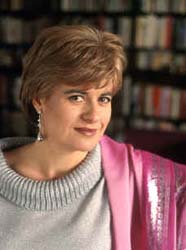 During the last few seasons, the mezzo-soprano Elena Gragera, born in Badajoz, Spain, has captured the attention of the Spanish musical world for the artistic quality of her interpretations, her sensitivity and precision.
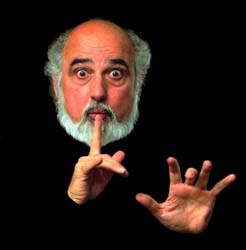 Elías Arizcuren is a conductor and violoncellist born in San Sebastián, studied with his father Gaspar Cassadó, André Navarra and Sandor Végh. He set up the Mendelssohn Trio in 1969 in Amsterdam, and toured prestigiously in Europe and the United States; it also has a vast recording history.
 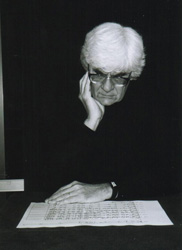 “I am an inventor of music motivated by the desire to create my own language, synthesis of my auditory and intellectual experiences organized in such a way as to achieve written compositions of the outmost rigour. I prefer an "impure" but living language to a "pure" dead language. I´d like to give permanent life to my visions and dreams, my nightmares even. I want them all to become comprehensible, as soon as I think they are worth being exposed and that they have enough energy and emotion in them to enable them to bring something of value to the lives of those who listen to them.”
 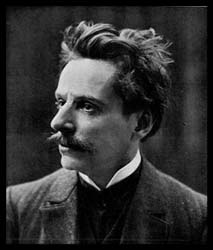 This Catalonian composer was born in Barcelona, immigrated to Argentina as a child, where he studied trumpet and organ. On his return to Barcelona, this young man studies piano with Albéniz, composition with Petrel. For perfecting, he travels to Brussels and has the privilege of being accompanist to Isaÿe. Under the influence of Strauss and Wagner, whom he openly admired, he succeeds with his orchestra compositions, operas and operettas, though his production includes chamber music, lied, choral music and many sardanas, a popular dance deeply-rooted in Catalonia.
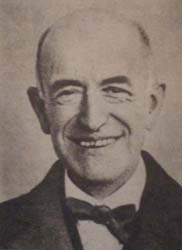 (Cádiz, 1876-Alta Gracia, Argentina, 1946). Isaac Albéniz, Enrique Granados and Manuel de Falla were considered as the great trilogy of the Nationalist Spanish music. De Falla was one of the first in this tradition that, cultivating an absolutely Spanish style, knew how to make himself known successfully in Europe and America. He never wrote much, but his almost perfect creations have a privileged place in every repertoire. The influence of Felipe Pedrell would be decisive in the conformation of his esthetic; he was the one to open autochthonous Spanish music to him. After receiving the first prize in a competition of the Real Academia de Bellas Artes de San Fernando with his opera La Vida Breve, France was the next stage in his professional formation. In 1907 he related to Debussy, Ravel, Dukas and Albéniz, clearly visible in his compositions of the time, particularly in Noches en los Jardines de España. When De Falla returns to Spain is when his creative maturity really starts. El Amor Brujo and El Sombrero de Tres Picos, the Fantasía baetica and the Siete Canciones Populares Españolas.
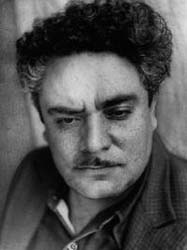 (Santiago Papasquiaro, México, 1899-Ciudad de México, 1940). He was a composer, violinist and orchestra conductor who had a brief but intense life. His musical formation as a violinist and orchestra conductor was received in his birthplace and in the United States, and he started to compose somewhat late, in his thirties, probably influenced by Carlos Chávez of whom he was assistant conductor between 1929 and 1935 in the Orquesta sinfónica de México. He traveled to Spain in 1937 and took an active part in the civil war in favor of the Republican band. Self-taught composer, his works are scarce but valuable, with titles as El renacuajo paseador, The promenading tadpole, (1933) and his orchestra compositions Ocho for the radio (1933), Redes (1935), Homenaje a Federico García Lorca, Homage to García Lorca, (1935) and La Noche de los Mayas, The Night of the Mayans, (1939). Sensemayá, The Snake, (1938), is his best known composition, well known both in Mexico and abroad. A very deep knowledge of the Mexican music and the dominance of rhythm grant Revueltas’ music a unique attractiveness. On returning to Mexico he lived an isolated life and died in complete poverty and abandonment. Revueltas and Carlos Chávez are probably the best known Mexican composers of the XX Century.
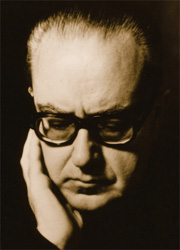 (Buenos Aires 1916, Genève 1983). A subjective nationalism is clearly perceived in the first period of his work. His compositions, based on popular Argentinian themes, include tonal melodic elements which, will culminate in 1954, in the popular Pampeana n°3 for orchestra. Subsequently he will be influenced by dodecaphonic music, though not too strictly. His artistic restlessness and natural curiosity led him also to experiment with quarter tones and other micro-intervals, polytonality and even with certain surrealism, with supernatural and fantastic connotations as the titles in some of his works transluce: Presto mágico, Scherzo alucinante, Scherzo fantastic. His production covers the symphonic genre, ballet, opera (Barrabás, Bomarzo, and Don Rodrigo), choral and vocal music and innumerable chamber works.
 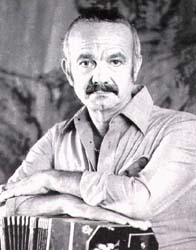 (Mar del Plata, Argentina 1921, Buenos Aires 1992). His childhood was spent between Buenos Aires and New York. He started musical studies in The United States when he was 9, and continued in Buenos Aires and Europe. He had an almost mystic encounter with Carlos Gardel when he took part as an extra in the film “El Día que me Quieras”.