 |
||||
  |
||||
 |
||||
 |
||||
 |
||||
 |
||||
 |
||||
 |
||||
 |
||||
|
||||
Síguenos en
|
||||


 |
 |
 |
 |
 |
 |
|
| Programa general | Andares | Saturday 29 Mercedes Medina, Bicentennial Music Venue: Foro Andares
Blvd. Puerta de Hierro 4965 / Zapopan, Jalisco Admission free Mercedes Medina
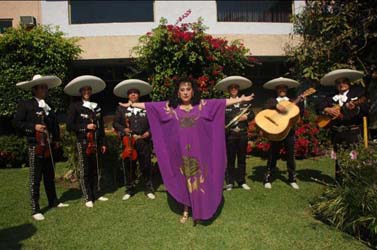
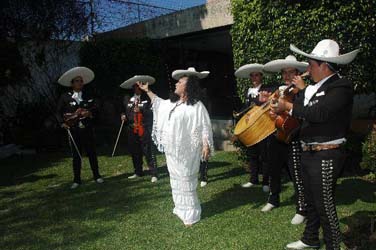
She started singing at university forums, taking part in groups of “estudiantinas” and other musical traditional and cultural groups. The Government of the state of Jalisco, through the Departamento de Bellas Artes, invited her to tour through most of the municipalities of Jalisco, and cultural exchange opportunities gave her a chance to sing all through Mexico. She was invited to present Traditional Mexican Music in Canada and the United States, also through cultural exchange institutions, and representing the state of Jalisco. She sings both in cultural or operatic events in different places in Mexico and abroad. In 1996, the Universidad de Guadalajara records a compilation made by Mercedes Medina on Mexican popular tradition music dating from 1692, and extending to the first decades of the XX Century, titled “Mi México de Ayer“.
Within the area of Difusión de Patrimonio Cultural (making our cultural heritage known), she was given a grant from the Fondo Estatal para la Cultura y las Artes in Jalisco, and in June 1988, with the possibilities the grant gave her, she launched a CD titled “Apasionada”, an anthology of music from Jalisco. On January 1999, Mercedes Medina, for second time, received a grant from the Fondo Estatal para la Cultura y las Artes within the area of Difusión de Patrimonio Cultural. She was selected by the Consejo Estatal para la Cultura y las Artes (CONACULTA), to give a concert representing the State of Jalisco in the Primera Muestra Nacional de Becarios in January l999, at the Centro Nacional de las Artes in Mexico City. In April 2000, she becomes part of the “Del Amor que te di” Project as an interpreter, that included the recording of a CD and a poetry and music show by the writer Dante Medina, which was sponsored by the Universidad de Guadalajara. In June 2000, Mercedes Medina was proposed by the Department of Culture in Jalisco to tour the “Circuito Centro-Occidente” giving 27 concerts, and she was accepted by CONACULTA and the Fondo Regional para la Cultura y las Artes to do so. In January 2001, Mercedes Medina, on request of the International Book Fair, records the commemorative CD for the XIX Anniversary of the Fair. She also takes part every year in the Encuentro Internacional del Mariachi y la Charrería, singing at the concerts named “Gala del México Antiguo”. November 2006 sees the launching of the CD “Viene la Muerte Cantando”, and she makes it together with the painter Lucía Maya, trying to preserve the Mexican tradition of “Día de Muertos”. Mercedes Medina goes Flamenco on May 2006 for the Festival Cultural de Mayo offered by the Department of Culture, and she received the invitation from the Festival Cultural de Fiestas de Octubre and the Entrepreneurs of the Historical Center of the City of Guadalajara, thus presenting the Project entitled “Nueva Pasión”. Academic and cultural institutions, as well as the European Community in Guadalajara, the Festival Cultural “Fiestas de Octubre”, the International Book Fair, the University of Michoacán at Saint Nicolás Hidalgo, invite her and painter Lucía Maya to take part in several cultural projects, as well as different companies like Telmex, the Pascual Boing Foundation, and the Asociación de Empresarios del Centro Histórico de Guadalajara.
Every year she is invited to present her shows in different countries: Spain, the United States and Canada. The Universidad de Guadalajara sponsors Mercedes Medina and includes her as a prospect within its groups and spaces catalog. The Culture Department of the state of Jalisco also lists her as one of its artists. Mercedes Medina devotes much of her time to compile traditional Mexican music, boleros, Flamenco music and to spread this cultural treasure that includes music and dance, and for this reason it is included in the main art scenarios and massive events, cultural and popular, presented in different states of the Mexican Republic and abroad. Traces of our Nationality Trying to conclude, one can say that Mexican music, in general, is integrated by native elements, African influence, Spanish rhythms sometimes contaminated by Arabian contact, as well as European influence in what is popular and in the concert repertoire. In other words, this music offers us an impressive variety. Going back to 1810, one can say that social classes were clearly defined then, as well as music genres for each of them: well-to-do people preferred the European styles, and the populace had its ‘sones de mariachi’, as ‘el frijolito, la ensalada, el gato, el jabalí’ and many others, with a proliferation of ‘jarabes’ that were danced at the Central Western part of the country and interpreted by groups of musicians (mariacheros) who were popular indigenous orchestras, whose costumes had nothing to do with the ‘charro’ suits, that were worn only by the rich land owners and cattlemen. All kinds of popular music were prohibited by the church until 1821, where Mexico’s Independence was finally granted, and it is then that the musicians recover freedom of expression and movement. 100 years later, within the scenario of the Mexican Revolution, the point of view on music had changed significantly: high society, after the French influence and the laissez-faire attitude to life during the Porfirio Díaz regime, enjoyed European music and waltzes, operettas and zarzuelas were in great demand. By then, Mexico had great music authors as Juventino Rosas and Manuel M. Ponce. But on the other hand, the popular music is enriched by the appearance of ‘the corrido’. The corrido started to be sung as a popular expression at the end of the XIX Century, and this narrated song spoke of the feats of those who rebelled against the government at the time. It attained its greatest popularity during the time comprised between the Madero Revolution (1910) and the end of the Cristero movement (1929). The inclusion of the cornet to mariachi during the revolutionary stage precedes the one of the bugle in 1940. The groups of luxury mariachis add a feminine voice to it, named Cancionera, the song singer woman. Within a colloquial and festive ambiance, the Independence and Revolutionary periods are re-created in this show, dressed wittily with oral tradition refrains, and enriched by dancers who change costume from 7 to 9 times per show. It is accompanied by a Traditional Mariachi, and this multidisciplinary show that includes performance, is extraordinary and unique on its own right, since it rescues our traditions. The program includes sones and jarabes that were danced around 1810 and that, as forbidden music, were interpreted on the way to battlefields. To create the atmosphere of the Mexican Revolution repertoire, some ‘corridos’ are included that bespeak of the first revolutionary restlessness, héroes of the Revolution, tragic feats. And to integrate this repertory, we have included some of the songs most ingrained in popular memory, as: El adiós del Soldado, la Negra Noche, Amémonos, and many others, all of them from the Revolutionary period. | Top | | Programa general | Andares | |