
 |
||||
  |
||||
 |
||||
 |
||||
 |
||||
 |
||||
 |
||||
 |
||||
 |
||||

|
||||
Síguenos en
|
||||


 |
 |
 |
 |
 |
 |
|
Wednesday 26 Venue: Templo de Aranzazú Program Part I Suite I in A minor - Manuel M. Ponce México (1882-1948) Prélude “Serie Sudamericana” - Héctor Ayala Argentina (1914-1989) I preludio( Colombia) "Canción y Danza” - Manuel Millán de las Heras Part II Sonatina Meridional - Manuel M. Ponce (1882-1948) I campo 2 Essential pieces for guitar - Juan Antonio Sánchez ( Chile 1970) I Tonada Por Despedida Suite Colombiana Nº 2 - Gentil Montaña (Colombia 1947) I Bambuco "Cinco Ecos de América" - Raúl Maldonado ( Argentina-1937) Eco I for Carlos fuentes, México Mauricio Díaz Álvarez He was born in Guadalajara, Mexico on April 21st, 1988. He has settled in France, where he works intensely as a guitar teacher at L’école de Musiques et de Dansedu Penthièvre, in Bretagne, (Music and Danse School at Penthièvre). He studied at the Real Conservatorio Superior de Música de Madrid under Gabriel Estarellas, where he got the highest marks. Mauricio Díaz is considered one of the best classic guitar interpreters of his generation.
He has been invited to give magister classes in several institutions:
His recordings:
He has given recitals in Germany, Spain, Mexico, Austria, France, Italy, Greece, Poland, Portugal, Slovakia, Belgium, Morocco, Gabon, Jordania, Egypt, Lebanon and India. He has taken part in several important International Festivals:
He has obtained many important and highly prestigious awards obtained in International Competitions:
He was invited as soloist to the Queen Sofía Camera Orchestra in 2000, under the conduction of Nicolás Chumachenco, violinist, in homage to Joaquín Rodrigo, Madrid. In May 2003 he was a guest soloist to the Philharmonic Queretaro Orchestra for the VI Guadalajara International Music Festival. He was invited by Jordania as soloist in 2003 to the Amman Philharmonic for the I International Amman Festival. In 2004, he was a guest soloist for the CVII Symphonic Summer Season in México. He was invited in 2004 by the Guerrero Foundation to be a member of the Jury, together with two eminent Spanish Composers Antón G. Abril y Tomás Marco, for the XVI “DoñaInfanta Cristina” International Classical Guitar Competition. Mauricio Díaz Álvarez has premiered several guitar pieces:
Other invitations and appointments:
| Top | Program notes Raúl Maldonado, guitarrist y composer Raúl Maldonado was born on January 30, 1937 in María Susana, Santa Fe Province. His passion for popular Argentinian music started in his childhood, when the field workers, laborers or migrants herding cattle moved him with their songs, ingraining in him the daily creation of the common man. When he was twelve his parents moved to Rosario and his musical formation starts under Graciela Pomponio and Jorge Martínez Zárate. He later registers at the Instituto Superior de Música de la Universidad Nacional del Litoral, Santa Fe, where he continues for 8 years, also having, among other teachers, Juan Pedro Franze, Josefina Prelli. Musically restless, he travels to Europe in 1962, settling in France definitely in 1965, teaching since then at different Parisian conservatories, Issy le Moulineaux, Chaville, and Maisons Alfort. In 1989 he receives the Certification for Professional Aptitude and is appointed as Director of the Preparation Centre to obtain the same Diploma, residing in the Issy les Moulineaux and Versailles Conservatories. He is commissioned in 1998 y 1999 as Inspector for the Municipal Conservatories in the city of Paris. Retiring from teaching in 2003, he is honored with the Medal to Work Merits by the Government of the French Republic. Ha dado conciertos en la mayor parte de los países europeos: Portugal, España, Italia, Inglaterra, Bélgica, Holanda, Germán, Suecia, Suiza, Luxemburgo, Austria, Rumania, Poland, Bulgaria, Francia, así como Uruguay, Líbano, Marruecos, Túnez, etc., presentándose en Festivales tan importantes como Avignon, Córcega, Quercy,Aix , Internacional de París, de Música Religiosa de París, Festival del Tango de París, Estocolmo, Spoletto, Friburgo, La Reunión (Six cordes pour une Semaine) y Buenos Aires (Guitarras en Concierto, Guitarras del Mundo). In 2003, on a special commission of the Argentina Embassy in Paris, he represents his country in the Spanish American Guitar Festival, organized by the Beirut Cervantes Institute. His activity as composer has a catalogue of 170 pieces, and more than 120 have been edited. Among other titles, it includes his “New World Cantatas”, first played at the Sainte Chapelle in Paris, with Ana Maria Miranda, Los Calchaquis and the Sorbonne Choir; “Tupac Amaru”, based on poems by Atahualpa Yupanqui, followed by “My Songfrom the South”, presented in France during the Vaison-La-Romaine, the most important choral manifestation of the country. “The Singing Boy” and “Río Viejo Songs”), “Guitar and Orchestra Concerto” , “Two Guitars and Orchestra Concerto”, “Stories from the Enchanted Valley” (For three guitars and charango), “Guitar Legend” (For two guitars and recorded by the Peragallo-Pedroni Duo, and also “Works from Santa Fe Composers”, etc. In 1999 the “Lutecia” Guitar Quartet cuts a C.D. with only his Works, which obtained the prestigious “Five Tuning Forks” award granted by specialized French critics. “Soplos del Sur” (Southern Winds) is presented in 2001, for a string trio and flute, premiered at the Massy and Levalos Festivals in the Parisian region, as well as “Venezoleando”, for a guitar orchestra and four soloists, originated at the Vandoeuvre Fifth Guitar Encounters in la Lorraine. His Suite “Paranasera” for three guitars is created in 2002, in the Le Creusot Guitar Festival, and it was adapted in 2004 for accordion and guitar. His Suite “De Lejos” (From Far Away) for four guitars, 2003, was first played by the Lutecia Quartet and then interpreted in several French and European Festivals. The Duo Covarrubias presented in 2004 his work for harp and guitar during the International de Bourges Festival. La Salle Cortot in Paris premieres successfully his Quintet for Guitar and Strings in 2005, interpreted by the Mexican guitarist Mauricio Díaz Álvarez. Artists from Argentina, England, France, Portugal, Ukrania, Bulgaria, Armenia and many other countries have recorded several of his compositions. | Top | Gentil Montaña, composer
He started studying at the Ibagué Conservatory when he was seven. His first instrument was the violin, but at thirteen he adopted the guitar. His first teachers were Domingo Gonzalez and Daniel Baquero M., and studied harmony with Juan Carruba. His first recital at the Lido Theater in Medellín started his career as a concertist when he was nineteen and since then he is known as the initiator of classical guitar in Colombia. He advanced his contemporary music studies with Kakleen Keinell in Europe, specializing in instrumentation with Blas E. Atehortúa and Gustavo Yepes. He received the third prize in the first “Alirio Díaz” Guitar Worldwide Competition celebrated in Caracas in 1975. He was invited both as an interpreter and jury in 1994 and in 2002 to this Competition. In his country, among others, he has played as soloist with the Bogotá Philharmonic, Colombia Symphony, Antioquia Symphony, Colegium Musicum, Colombia Chamera Orchestra and the Conservatory. He has toured the main concert halls at Colombia and in the world: Spain, France, Germany, Switzerland, Greece, Italy, Venezuela, Chile, Uruguay, Paraguay, Argentina, Cuba, Costa Rica, Ecuador, the United States and England. He was guitar professor between 1996-1972, and from 1983 to 2001 at the Luis A. Calvo Academy, and has also taught at the Universidad Pedagógica Nacional from 1985 to 1996, and in 1991 he gave classes at the National University Music Conservatory. Guitar competitions both in Colombia and other countries have invited him to be a member of the jury: First Spanish-American Guitar Competition, sponsored by the Music Art Foundation and others, “Alirio Díaz" International Guitar Competition, the “Anselmo Durán Plazas” National Music Interpretation Competition, the Pasillo Colombiano Festival; the "Colono de Oro" en Florencia, the "Príncipes de la canción" Festival at Ibagué. He won a Colcultura scholarship for composition. He has seven records as a soloist. He cut one in honor of the King and Queen of Spain with the Bogotá Philharmonic with Independence music by Carmen Caycedo; there is another for Carré, in France, honoring Agustín Barrios Mangoré. In 1964 and 1965 he recorded for Discos Zeida, and also cut a CD in 1967 and phonograms for Discos Bambuco. He was recently invited to conduct a Master Class at the Paris Conservatoire Superieur de Musique, and another at the Charles Darwin University in Australia. Gentil Montaña is not only successful as an interpreter; he is also a prestigious composer, highly respected among the great virtuosi Latin American composers like Agustín Barrios-Mangoré, Heitor Villa-Lobos, Antonio Lauro, Leo Brouwer and Manuel M. Ponce. | Top | Héctor Ayala, composer
Héctor Ayala, (April 11, 1914 – March 11, 1914) was an Argentinian composer and guitarist. Ayala was born in Concordia, at the Entre Ríos Province. He started his career as guitarist in Buenos Aires, making his debut in 1936 accompanying tango and folklore singers. He later joined the Guitar Squadrons, ensemble formed by 12 to 15 guitars and conducted by Abel Fleury. During the decade of 1950 he worked in Buenos Aires radio stations, and participated in Aníbal Troilo’s quartet. Héctor Ayala composed many important works for the guitar, including some inspire don music from Argentina and other Latin American countries. He also wrote several teaching methods for the guitar. His best known work is the American Series (Ed. Aromo, 1962.) Ayala died in Buenos Aires on March 12, 1990. | Top | Manuel Millán de las Heras, composer
José Luis de la Fuente Charfolé, Rafael Eguílaz, José Calvo and José Miguel Moreno Sabio teach him harmony, counterpoint, fugue and composition, he then takes specialization coursees with Tristán Murail, Leonardo Balada, José Luis de Delás and Gabriel Brnčić. Practically all his work has been played; he has received requests from different soloists, groups and festivals, such as the pianist Manuel Ángel Ramírez, the guitarist Mauricio Díaz Álvarez, the orchestra director José Ramón Monreal, the La Mancha Symphonic Orchestra. His compositions have been heard in different Festivals, such as the La Mancha International Music Festival (Quintanar de la Orden, Toledo), Lublin International Guitar Festival, (Poland), Cycle of XX Century Sonatas for the “Juan March” Foundation (Madrid); Saint Isidro Piano Festival (Talavera de la Reina, Toledo) or the I Young Interpreter Cycle (Cuenca). His music has been premiered by orchestras like the La Mancha Symphony, Cuenca Philharmonic or the Lublin Symphony, interpreted by soloists as Manuel Ángel Ramírez, Gregorio Benítez Suárez, Lucas Martino or José Manuel Montero. He has been awarded the “Manuel Castillo” IV International Composition Competition for his “String Quartet No. 1” He combines both his composer and interpreter abilities with critique, and collaborates with the magazine Ritmo, the group El Día and the ABC. | Top | Juan Antonio Sánchez, composer
He starts his musical studies early by means of the Latin American folklore, takes part in different Latin American music groups in Argentina, Mexico and Mozambique where he lives in exile with his family. On returning to Chile, he licentiates in music for the Universidad de Chile, takes guitar with Oscar Ohlsen, traverse flute with Albert Harms and composition at Workshop 33. He later studies composition with Leo Maslíah (1994), and composition for guitar under Egberto Gismonti (2005 and 2006.) In Chile he has participated in different groups: Terra Nova, Enrama and Palo Santo, and has worked close to Antonio Restucci, Francesca Ancarola, Fernando Carrasco, Magdalena Matte and Pancho Amenabar, among others. He has also collaborated with Patricio Manns and the group Santiago del Nuevo Extremo. As a soloist and also with different groups, he has toured in México, Argentina, Brazil, Ecuador and Bolivia. He took part in the “Guitarras del Mundo” (Guitars of the World) Festival at Buenos Aires in 1999, and in the “Entrecuerdas” Festival, at Santiago de Chile in 2000, 2001, 2002 and 2003. He has recorded twice as a soloist: (“Local 47”, 2001, and “Soyobré”, 2003) and also published in 2002 “13 Piezas Esenciales para Guitarra”, with his own compositions, and a didactic book in 2007, “Recorriendo el Laberinto”. Several outstanding musicians have recorded him and play his Works, as José Antonio Escobar, Luis Orlandini, Romilio Orellana, Osvaldo Burucuá, Jaime Kechele, theLatin American Sax Quartet, the Serenade Ensemble and the “Krinetic Quartet” among others. He was selected as the “best fusion composer” in 1998 by the Chilean Copyright Society, obtaining the Altazor prize for his “Local 47” CD in 2002. He lives in Madrid since the last part of 2003 and has worked as flutist for the Antonio Márquez Company (2004) and as guitarist with Gisela Baum, Graciela Marín and the Cholga Trío, giving soloist recitals in Madrid, Valencia, Barcelona, Copenhagen and Luxemburg. | Top | Manuel M. Ponce, composer
When Ponce entered the National Music Conservatory, he already had a certain prestige as composer and pianist. He remained there until 1903. In 1904 he went to Italy and could be accepted at the Liceo de Bolonia to take superior music studies there. He studied in Germany between 1906 and 1908 then returning to Mexico to take charge of the piano and History of Music classes. He wrote one composition for the left hand honoring the one-handed sculptor Jesús F. Contreras, which he titled "Malgré tout" (A pesar de todo) In 1912 he wrote his masterpiece, “Estrellita”, not exactly a love song but living nostalgic feelings, a complaint for youth ebbing away. On that same year he gave at the Teatro Nacional the memorable Popular Mexican Music concerto that scandalized the ardent defenders or European traditions, but constituted a fundamental landmark in the history of national songs. With this valuable promotional activity for the music of his country, and with melodies like “Estrellita" (Little Star), “A la orilla de un palmar" (By the Palm Grove), "Alevántate" (Wake up), "La Pajarera" (Bird-selling Woman), "Marchita el alma" (Withered Soul) and many more, Ponce won the honorific title of “Creator of the Modern Mexican Song”. He also was the first Mexican composer who projected his music abroad: "Estrellita", for example, has been part of the repertoire of the main orchestras all over the world and of innumerable singers, though frequently those who interpret it know neither the origins of the song nor the author’s name. His body rests at the Rotonda de los Hombres Ilustres in the Dolores Cemetery, Mexico City. There is a recognition plaque on the back of the Exedra column, by the fountain devoted to this poet and musician. | Top |
|

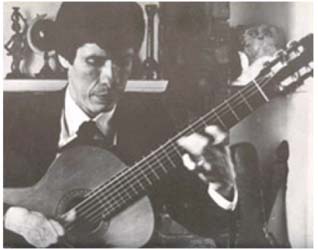 Julio Gentil Albarracín Montaña, known as Gentil Montaña was born in Colombia at Ibagué, 24 November, 1942. He is both a composer and plays the guitar.
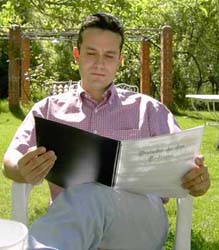 He was born in Cuenca, Spain in 197, where he started studying music, and a few years after, he moves to Madrid to learn under Gabriel Estarellas, achieving the Diploma of Superior Guitar Studies with the highest marks. He specializes in antique music with Jesús Sánchez and Jorge Fresno.
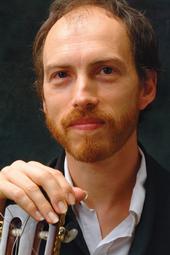 Sanchez is a Chilean guitar player and composer born in Berlin, September 7, 1965.
 He was born in Zacatecas in 1882, and, according to his biographers, he was famous for being “a musical phenomenon”. He was less than four years old when, after carefully listening to the piano lessons his sister Josephine received, he sat himself in front of the instrument and immediately interpreted one of the pieces he had heard. His parents set up piano and solfegge lessons for him. During his first years, Manuel’s compositions were gavottes, waltzes and other similarly inspired melodies. But on growing up, the sad tunes with some happiness traits or the happy ones touched with sadness that he heard, would make Ponce integrate a concept intuited from his teenage years: that popular Mexican music, if refined and methodized without discarding its original essence, would not only become something quite dignified and valuable, but it would also have great possibilities of being accepted all over the world.