 |
||||
  |
||||
 |
||||
 |
||||
 |
||||
 |
||||
 |
||||
 |
||||
 |
||||
|
||||
Síguenos en
|
||||


 |
 |
 |
 |
 |
 |
|
| Programa general | Teatro Degollado | Friday 28 Tangos Concertantes Néstor Marconi and Orchestra Admisión: de $300.00 a $400.00 Nestor Marconi, bandoneonist
He started his career as a classical music composer and interpreter in the international circuit in the 90’s interpreting Piazzolla’s Concerto for Bandoneon and Orchestra, his own arrangements for other tangos and some of the works he has composed in Gothenburg (Sweden), Oslo Philharmonic (Norway), Victoria Symphony (Australia), Toulouse Philharmonic (France) and the Vancouver and Montréal Symphony (Canada), among other groups in England, Switzerland, Austria and the United States, as well as the Stable and Philharmonic Colon Theater in Buenos Aires and the National Symphony, under the conduction of Charles Dutoit, Pedro García Calderón, Jorge García Navarro, and many others. In December 1977, together with Yo-Yo Ma, he made an important tour through Seattle, Los Angeles, Miami, Washington and New York presenting the CD “Tango Soul”, based on Astor Piazzolla´s music for the show “Yo-Yo Ma and Friends”. In 1998 he took part in Carlos Saura’s film “Tango” and two years later, he recorded and played Lalo Schifrin “Esperanto” concert in Cologne (Köln), Germany. He has also taken part in innumerable festivals in France, New Zealand, Sweden, Spain, Norway, Germany and Brazil with his own groups: the “Nestor Marconi Trio” and the “Nestor Marconi Quintet”. Participant in the International Tango Festival in Buenos Aires, he has also cut CDs as interpreter arranger and composer for Milan Sur (Argentina), Milan (France), JVC-Victor (Japan) and Sony Classical, though now he is exclusive for Warner Music. Soloist for the “Argerich’s Meeting Point” at Beppu, Japan, in April 2006, Marconi performed that same year in June for the “Buenos Aires Tango 3” Festival in Paris (Théâtre National de Chaillot) and in Brussels (Théâtre de Beaux Arts). September saw him as a soloist with the Orquesta Filarmónica del Teatro Colón under Lalo Schifrin, and also took part in November’s homage to Astor Piazzolla. He takes charge in March 2007 of the Tango School Orchestra “Emilio Balcarce”, composing “Cameratangos” during the same year, which is a concerted work for soloist bandoneon and string orchestra, written honoring the 40th anniversary of the “Camerata Bariloche”, which was premiered by them, with the composer as soloist on April 14, 1007 at the “Pilar Golf” in Pilar, Buenos Aires. On July 13, same year, he interprets “Tangos Concertantes” and “Cameratangos”, under the conduction of Reinaldo Zemba, responding to an invitation by the Entre Ríos Culture Secretariat and the Medical Circle. He is now in charge of conducting the Buenos Aires Tango Orchestra. | Top | Orquesta Filarmónica de Jalisco In 1915, under the initiative of Maestro José Rolón, a group of musicians from Jalisco started offering symphonic and camera concert music to Guadalajara audiences, thus establishing the starting point for what in the future would be the Guadalajara Symphonic Orchestra (Orquesta Sinfónica de Guadalajara). The orchestra was managed by the Concert Society (Sociedad de Conciertos) between 1915-1924, which had a director’s board, was sponsored by private institutions and received the State Government subsidy, interrupted in 1923 and this caused the disappearance of the organisation. Nevertheless, the musicians continued working to prevent the Orchestra from being completely obliterated, and obtained economical support from Governor José Guadalupe Zuno. It must be mentioned that Don Pedro González Peña was completely devoted to the Orchestra up to 1939.
In February 1942, while Guadalajara was celebrating its 4th Centennial, Maestro Leslie Hodge was on holiday there, and when he heard classical music played by some musicians, he approached them, willing to get acquainted encouraging them to constitute a formal orchestra. He was invited to organize it and conduct it, but at that moment he already had other commitments, promising to return after the end of World War II, and in view of this offering, the Friends of Music Association (Asociación de Amigos de la Música) requested from the Governor, Marcelino García Barragán to guarantee the survival of the orchestra until Mr. Hodge returned, and thus he became the first conductor of the Guadalajara Symphonic Orchestra. This sponsorship was sustained until 1950, year on which an association was constituted, Conciertos Guadalajara, A.C. (Guadalajara Concerts, A.C.), which sponsored the Guadalajara Symphonic Orchestra with state, municipal and private institutions funding. The Guadalajara Symphonic Orchestra became part of the Arts Department in the State of Jalisco in 19971, which since then, has taken care of its artistic level and economic concerns. Directors working with the orchestra have recognized it as adaptable and versatile, averaging 60 yearly appearances among concerts, opera and ballet. It has been conducted by famous musicians, such as Leslie Hodge, Abel Eisenberg, Helmut Goldman, Eduardo Mata, Kenneth Klein, Hugo Jan Huss, Francisco Orozco, Manuel de Elías, José Guadalupe Flores, Guillermo Salvador and Luis Herrera de la Fuente. Some of the soloists have been Paul Badura-Skoda, Claudio Arrau, Jörg Demus, Henryk Szering, Plácido Domingo; Alfred Brendel, Bernard Flavigny, Jean Pierre Rampal, and Narciso Yepez, among others.
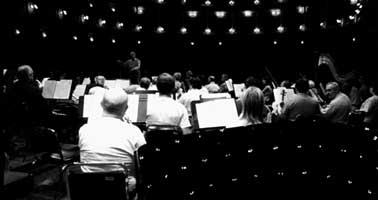
The Guadalajara Symphonic Orchestra changed its name in 1988, giving birth to the Jalisco Philharmonic (Filarmónica de Jalisco). It was intended that the whole State of Jalisco would receive its benefits. Every member of the orchestra has been selected for the quality of auditions given by aspiring interpreters, selecting its members among the very best to guarantee uniformity in sound and technical perfection of performance each of them should have. This allows us to consider that the Jalisco Philharmonic can gallantly measure up to all kinds of repertoire, including the most ambitious modern compositions. Héctor Guzmán has been the new conductor in charge of the Jalisco Philharmonic since May 2004. Héctor Guzmán, conductor
He has been Guest Conductor of the important Symphonic orchestras in Mexico: OFUNAM, Xalapa, State of Mexico, Bellas Artes Chamber Orchestra, Monterrey, the Mexico City Philharmonic, and the National Symphonic Orchestra. He has also conducted orchestras in Dallas, San Antonio, Wheeling; the Dominican Republic National Symphony Orchestra, the Collegium Orchestra at Lichtenstein Palace in the Prague Music Academy at the Check Republic, the Japan Philharmonic, the Amadeus Orchestra, the Milan Classical Orchestra in Italy and the Murcia Symphonic in Spain among others. In 2005 he made his operatic debut with the opera The Barber of Seville, and in 2007 conducted the premiere in Mexico of the Spanish version of ‘Frida’, a very successful opera. Recognized for his international work, he has received prizes such as the Lira de Oro in Mexico, the Meadows Award, the ‘Director par Excellence’ granted by the Technological De Vry Institute in the United States and the 2005 Medal to Artistic Merit, the highest decoration granted by the Government of the State of Mexico through the Music Conservatory at the State of Mexico. He was awarded the Candelario Huizar Artistic Merit Medal 2006, granted by his birth state, Zacatecas. In 2004, Héctor Guzmán was named Distinguished Citizen by the North American Association ‘Sons of the American Revolution’ for his artistic world wide level contribution. In 2000 he was included in the book ‘Great Musicians of the XX Century’, edited by the Biographical Cambridge Institute. In April 2007, Irving City and the Deputies Chamber for the State of Texas granted Maestro Guzmán a special recognition for the international level of his Artistic Career, and in 2008 he received the Mozart Medal from the Austrian Embassy, top recognition in Mexico for academic music excellence. | Top | Dancing Corps
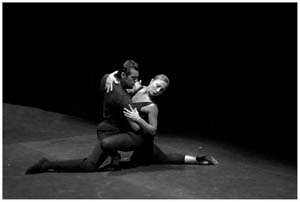
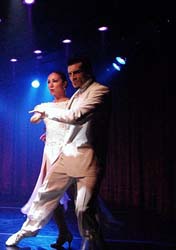
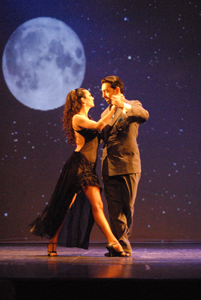
A dancing corps that includes artists highly experienced in dancing the Argentine Tango and that have captivated the whole world with the sensuality that permeates from their dance: Silvio Grand and Mayra Galante, Ricardo Astrada and Silvina Pino, Demián García and Noelia Soldera, and John Galindo and Angie González. The show offers a tour through the history of the Tango, with the technical and expressive virtuosity required to show what Buenos Aires considers as a word of mouth concept, transmitted from one generation to another. It reveals the authenticity of the real tango where bodies speak by themselves and no introductions are needed. The dancers have offered their art in the most transcendent theaters of the world: the Capella Hall at the Hermitage Museum in Saint Petersburg, the Kremlin Theater in Moscow, the National Theater and the Metropolitan Theater in Mexico City. They have also been present at the most important Art Festivals in America, Asia and Europe. On this occasion, they will be accompanied by Nestor Marconi, the great Bandoneon Master. Silvio Grand and Mayra Galante They have starred in concerts such as “Tango with the Stars” at the Capella Concert Hall in the Hermitage Museum, and on repeated occasions interpreted “Dreams about Tango” at the National Theater of Musical Comedy in Saint Petersburg and in the Theater Music-House in Moscow. They also participated in the Vladivostok Tango and Argentine Film Festival in Russia, where they danced at the Maxim Gorki Theater and the Fesco Concert Hall. They took part in the Riga, Latvia Tango Festival; the Oulu Tango Festival in Finland, and the Barletta Festival in Puglia, Italy. They have integrated casts of art companies as Esquina Carlos Gardel and the Juan Carlos Copes Company, dancing on famous stages as the Saint Petersburg Oktober, and Moscow’s Kremlin Theater. They have also appeared in Buenos Aires' Luna Park; the Riga Kongressu Nama, in Latvia; the Metropolitan in Mexico City; the Teatro Popular Melico Salazar in Costa Rica; the Verdi Theater in Italia; the Teatro Nacional Rubén Darío in Nicaragua; the Teatro Liceo in Buenos Aires; the Dominican Republic National Theater, and many others. In all, adding performances and shows, they have been to more tan 20 countries in America, Europe and Asia. They have given master class and seminars in dance schools and have also participated in festivals in Europe, Mexico, Japan and Russia. Among the cinema and televised productions where they can be seen dancing, we have the documentary “On Stage, Mayra Galante and Silvio Grand… Ten Years together”; “Only Tango The Show, Russian Tour”; the documentary “Tango, a Strange Turn” and several televised productions for the Argentine cable signal “Only Tango”, such as “Mayra Galante and Silvio Grand Special” and “Tango Around the World”. They were the image for international trademarks such as Citibank, Milonga Liquor, Bridgestone, Satellite TeLeFe, and of the Argentine channel “Sólo Tango” (Only Tango).
| Top |
His career really started when he played as bandoneonist in Aníbal Troilo’s orchestsra. He wins a French government scholarship to study with Nadia Boulanger, who motivated him to follow his own style. He returns home in 1955 and creates the Buenos Aires Octet. Together with his musicians, in a very similar experience to the one Gerry Mulligan had as jazz interpreter in the United States, he winds up making daring arrangements and using unusual combinations for the tango, such as the introduction of the electric guitar.
|
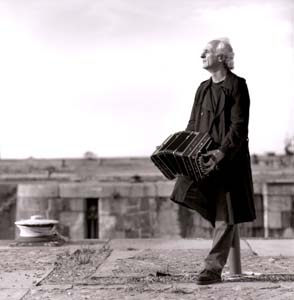 Marconi is one of the most outstanding living bandoneon interpreters in the world; since the 1970’s, his name has been closely associated to Horacio Salgan, Astor Piazzolla, Héctor Stamponi and Enrique Fracini. During the decade of the 80’s he was involved in Astor Piazzolla and Horacio Ferrer’s opera-tango project “María de Buenos Aires” (María from Buenos Aires). He also toured with Carlos Copes and the Argentinian ballet through the United States, Central America, Brazil, Uruguay, Spain, France, Denmark, Sweden, Norway, Finland, Germany and Japan. He is a transcending figure in the world tango encyclopedia, presently considered as one of the most important and well known bandoneon players in the world.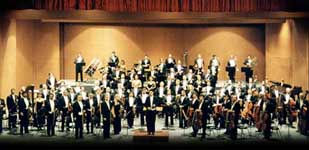
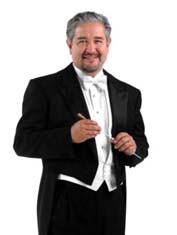 Maestro Héctor Guzmán is nowadays respected internationally as one of the most outstanding Mexican musicians and is now Conductor of the Symphonic orchestras at Plano, Irving and San Angelo in the United States. In 2004, he won the International Contest ‘Seven Conductors for a Baton’, and was officially named Conductor of the Jalisco Philharmonic Orchestra, confirming his place as one of the most important and outstanding podium figures for Mexico and the world.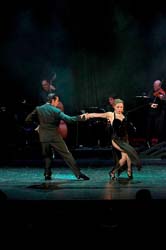
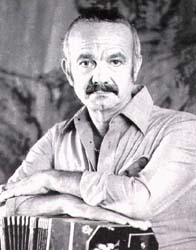 (Mar del Plata, Argentina 1921, Buenos Aires 1992). His childhood was spent between Buenos Aires and New York. He started musical studies in The United States when he was 9, and continued in Buenos Aires and Europe. He had an almost mystic encounter with Carlos Gardel when he took part as an extra in the film “El Día que me Quieras”.