
 |
||||
  |
||||
 |
||||
 |
||||
 |
||||
 |
||||
 |
||||
 |
||||
 |
||||
|
||||
Síguenos en
|
||||


 |
 |
 |
 |
 |
 |
|
| Programa general | Instituto Cultural Cabañas | Exposiciones | Friday 14 Fernando Botero (Colombia) "Fernando Botero. El Dolor de Colombia"
Pastel, pencil, charcoal on canvas, pencil, watercolor, pencil, ink, pencil, chalk and oil. From May 14 to June 30 Time: 20:30 hrs.
THE WITNESSING ART (ART AS WITNESS)
Even if he does not live in Colombia, Fernando Botero has not left out in his work what the daily life of the country is. He evokes the houses, villages, landscapes, characters, and also the mores of an “amiable world”. But, as the artist says, “Colombia also has that terrible face of violence.” In this exhibition works, representing people who lived the recent and tragic events, he manifests that situation without judgment, but rejecting violence. The theme itself is estranged from the concept of art as a source of pleasure. “In view of the scope of the drama Colombia is living”, he says, “a moment came when I felt the moral duty of leaving testimony over such an irrational moment in our history.” Nevertheless, the theme of violence is something he touched before . During the decade of 1960, he painted a mural for the Central Mortgage Bank (Banco Central Hipotecario, Masacre de los Inocentes (Massacre of the Innocent ones) and El Secuestro (The Kidnapping), where violence in the midst of the XX century is alluded. In 1973, he painted War, (Guerra), in which he crowds military men, priests, women, children, as if it were a battlefield. He also showed interest in taking histories out of different periods, as is the case of his paintings Las Noches del doctor Mata (The Nights of Doctor Kill), 1963; Teresita la descuartizada (Teresita Cut in Pieces), 1963, and El asesinato de Rosa Calderón (Rosa Calderón’s Murder), 1970. All these facts were serially commented in the yellow press of El Tiempo. Twenty years after, he dedicates part of his work to the most recent violet acts. From 1999 on, the artist recreates in paintings the dramatic situation the country lives in. His canvases are remnants of historical moments in which he picks up the “dark folklore” when representing the dead of Pablo Escobar or the portrait of Manuel Marulanda Vélez, “Sureshot.” In a way, these are chronicles originated by Botero´s idea that realism is not expressed in political art, but in “a commitment between what we see and what we know.” DRAWINGS
In this series of drawings, “it seems as if the line wanted to create a parenthesis in the virtuosity that relates Botero to Ingres. It is as if a mute despair or a knot in the throat could guide the hand with haste, wrapping shapes by means of sanguine or graphite. In them, precisely, one can appreciate with greater clarity the facial expression, the body language of the emotional state related to violence and its consequences.”* * Santiago Londoño, “Testimonio de la barbarie” (Testimony to savagery) in: Botero at Colombia National Museum. New donation, 2004. VIOLENCE AT THE END OF THE XX CENTURY
When cartel heads faced the possibility of extradition to the United States, the “Extraditables” appeared and they, through kidnapping terrorism and murdering judges and district attorneys, as well as government intelligence chiefs and other public figures would strongly press the Estate to prevent the signing of the treaty. At the end of the 80s, this situation was becoming critical because the government was also facing fights between the paramilitary forces and the guerilla for controlling the territory, and the extreme right groups systematically eliminated former subversive group members who had reintegrated to civilian life. The character of Colombian violence, equally cruel and still in presence of drug dealing, surprisingly turned at the en of the 80s and beginning of the 90s when the main drug-terrorism heads, though not the only ones who were violent, would become the guerrilla and the paramilitary, who turned the illegal drug dealing into an income source. As a consequence of the conflict, more tan a million and a half Colombians have left their country since 1955. Political violence increased after 1997, not only by those dead in combat, but with the continuous homicides, kidnaps, extortions and attempts against civilians. | Top |
| Programa general | Instituto Cultural Cabañas | Exposiciones | |


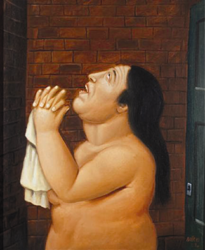 In 2000, Fernando Botero made the most important donation to date by a Colombian artist to the museums of his country. He gave his own paintings and drawings as well as an important international art collection for the cities of Bogotá and Medellín. Philanthropy has been a constant in his career, and public institutions such as the National Colombia Museum have several times received the benefit of his generosity, which has allowed them to complete the painting collection of the artist’s work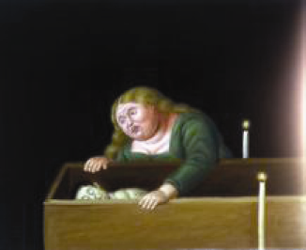
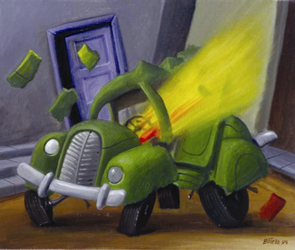
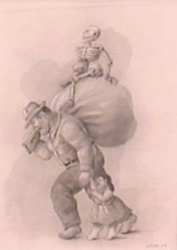 Botero has been, from the very beginning, a sketcher. His drawings are independent from his paintings; he shapes his ideas in them with the same intensity. Since he masters all techniques for pencil, charcoal, ink, pastels, and water colors, he can thus vary shapes, supports, forcing volumes to shape the surface of his work. In that sense, he acts like an academy product that imposes his shapes, thanks to his knowledge of his trade.
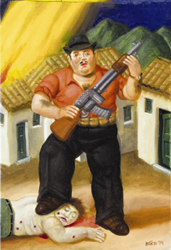 Regardless of establishing a direct connection between the scenes of this exhibition and the facts that have taken place in Colombia during the last decades, Botero’s work makes a general innuendo to violence, intensified since the 80s. It is at that moment that the illicit drug traffic business triggers crime rates.